The innovation of CALL leads to form a new research area for autonomous learning. Wolff (1997) claims that computers can offer ways of promoting learners the independence and interdependence while facilitating the construction of knowledge about the target language and enhancing the development of language skills. The environment provided by CALL is of great importance in fostering learner autonomy.
To begin with, CALL environment supported by multimedia and the Internet helps learners promote active learning and create authentic learning experiences by engaging in web-based researches, exploring concepts in a multimedia presentation and creating slides for a presentation. Moreover, the web creates numerous opportunities for "discovery learning”. The web can transport learners to a world with lots of information visually, audibly, and virtually. Learners can break down classroom walls with technology; the web and their active imagination allow them to learn what they want. Therefore, learners often feel more motivated to practice the language when they use a computer and autonomous learning can be easily and comfortably initiated and promoted via the computer technology compared with the conventional methods.
Next, CALL supports students with great control over their learning since they can not only study by their own paces but even by their own individual paths, going forward and backward to preview or review different parts of the program on particular aspects and skipping other aspects. Moreover, while CALL creates a setting of focusing on the main content or information, learners can have access to a variety of background-related links which will allow them rapid access to grammatical explanations or exercises, vocabulary glosses, online dictionaries, pronunciation information, or questions or prompts which encourage them to adopt an appropriate learning strategy.
Then, Learning supported by CALL allows learners to build a "cognitive scaffold" (Shelly, Cashman & Gunter, 2002), which is a mental bridge to build an understanding of complicated concepts. More significantly, the networked computers make learners’ communication beyond the classroom walls, thus enabling schools and communities to provide an environment for cooperative learning and the development of innovative opportunities for language learning. Instead of working alone on computer activities and projects, learners benefit from sharing ideas, discussing learning skills, and helping one another to approach tasks or achieve learning goals by e-mailing, chatting, conferencing and even web-authoring. In a word, the computer technology can serve as a good scaffolding device for autonomous language learning.
Nonetheless, it should be noted that the opportunities of fostering autonomy provided by CALL do not guarantee the positive outcome of autonomous learning.
Several disadvantageous factors like the physical limits or teachers’ technological confines will probably deter its inherent functions in language learning. Apart from those, learners’ lack of technical competence, dissatisfactory strategic performance online will also reduce the effectiveness of autonomous learning under it. Even worse, critics have pointed out that too many links and connections could bring on disorientation to students and multimedia resources may turn out to be too seductive an information source that learners may feel information overloaded. In this case, autonomy under CALL seems not easy to be achieved.
All in all, the computer technology is a two-edged resource, which on the one hand, can facilitate the language learning and foster the autonomy, on the other hand, can block the full play of learner autonomy someway or other. Then how to make good use of the technology to achieve a favorable extent of autonomous language learning?
Friday, April 23, 2010

Sample Application of Datd-driven Learning
Activity : reason+because
Aim of the activity: Correctness is often an issue with foreign language students. In this case on-line corpora can be used simply as a reference source. The sample also shows how the browser's search function can be used. The corpus that is used here is fairly small which makes the outcome slightly more predictable.
Question for students: How acceptable is a construction like this:"The reason is because he didn't want to harm her?”
Ask the students to open their WWW browser and point it to the VLC Web Concordancer at http://vlc.polyu.edu.hk/.
In the "Key Words" type "reason" and press the "Go" button. Wait a few seconds for the concordances to come up. The screen should look like the image below.

Reflection:
The expression "reason+because" is widely used by Chinese students. But actually it is not so for natives. This is an experimental research made by the students. All the teacher needs to do is arouse the students' thinking. The students can have their own hypothesis about the grammar in question first. Then they consult the corpora to verify their hypothesis. This kind of learning is actually doing research. No one will lose interest in such a study. There are many other questions needing such research. DDL is very efficient in solving such problems.
Aim of the activity: Correctness is often an issue with foreign language students. In this case on-line corpora can be used simply as a reference source. The sample also shows how the browser's search function can be used. The corpus that is used here is fairly small which makes the outcome slightly more predictable.
Question for students: How acceptable is a construction like this:"The reason is because he didn't want to harm her?”
Ask the students to open their WWW browser and point it to the VLC Web Concordancer at http://vlc.polyu.edu.hk/.
In the "Key Words" type "reason" and press the "Go" button. Wait a few seconds for the concordances to come up. The screen should look like the image below.

Use the browser's search feature to find instances of "because". Examine the lines that this search returns. The students are required to pick up all the instances of "reason+because". Then look at the context of these instances by clicking on "reason" in the relevant line.
The expression "reason+because" is widely used by Chinese students. But actually it is not so for natives. This is an experimental research made by the students. All the teacher needs to do is arouse the students' thinking. The students can have their own hypothesis about the grammar in question first. Then they consult the corpora to verify their hypothesis. This kind of learning is actually doing research. No one will lose interest in such a study. There are many other questions needing such research. DDL is very efficient in solving such problems.
Reflection on Data-driven Learning
It is well acknowledged that grammar teaching, which has long been regarded as one of the most important aspects of EFLT, bears serious problems.
Traditionally grammar is seen as a static product that consists of forms that are rule-governed, sentence-level, absolute, and constitute a closed system. However, grammar should be regarded as a dynamic process in which forms have meanings and uses in a rational, discursive, flexible, interconnected, and open system. In order to master the whole grammar system, students need to view grammar as an integration of morphosyntax, semantics and pragmatics, which can be called "dynamic grammar". With such a new conception of grammar, a new approach to grammar teaching is needed. Only with such a new approach can learners master the grammatical knowledge accurately, meaningfully, and appropriately. It is called DDL (data-driven learning).
DDL is defined by Johns as "the use in the classroom of computer-generated concordances to get students to explore regularities of patterning in the target language and the development of activities and exercises based on concordance output". He also describes his procedures of Identify-Classify-Generalize for classroom based concordance and data-driven learning. The basic idea of data-driven leaning can be summed up in the following points:
( i ) A focus on the exploitation of authentic materials even when dealing with tasks such as the acquisition of grammatical structures and lexical items.
( ii ) A focus on real, exploratory tasks and activities rather than traditional "drill and kill" exercises.
( iii) A focus on learner-centered activities.
( iv ) A focus on the use and exploitation of tools rather than ready-made or off-the-shelf learn-ware.
In practical grammar teaching, the students should be divided into two groups: intermediate-advanced and low-level students. To some low-level students, teachers should try to prepare some simple data from corpora and design some clear and easy lead-in exercises for them. They can learn to observe the collocations of some key words and try to work out some simple rules by themselves. After consulting the data, students should get the chance to see the texts with full sentence structures, which will be better for beginners to learn to study with DDL. To some proficient students, teachers should try to offer learning data as many as possible. Sometimes, teachers can even encourage them to process data on their own by means of some concordancing softwares, thus they can get the chance to deal with real data in corpora.
Traditionally grammar is seen as a static product that consists of forms that are rule-governed, sentence-level, absolute, and constitute a closed system. However, grammar should be regarded as a dynamic process in which forms have meanings and uses in a rational, discursive, flexible, interconnected, and open system. In order to master the whole grammar system, students need to view grammar as an integration of morphosyntax, semantics and pragmatics, which can be called "dynamic grammar". With such a new conception of grammar, a new approach to grammar teaching is needed. Only with such a new approach can learners master the grammatical knowledge accurately, meaningfully, and appropriately. It is called DDL (data-driven learning).
DDL is defined by Johns as "the use in the classroom of computer-generated concordances to get students to explore regularities of patterning in the target language and the development of activities and exercises based on concordance output". He also describes his procedures of Identify-Classify-Generalize for classroom based concordance and data-driven learning. The basic idea of data-driven leaning can be summed up in the following points:
( i ) A focus on the exploitation of authentic materials even when dealing with tasks such as the acquisition of grammatical structures and lexical items.
( ii ) A focus on real, exploratory tasks and activities rather than traditional "drill and kill" exercises.
( iii) A focus on learner-centered activities.
( iv ) A focus on the use and exploitation of tools rather than ready-made or off-the-shelf learn-ware.
In practical grammar teaching, the students should be divided into two groups: intermediate-advanced and low-level students. To some low-level students, teachers should try to prepare some simple data from corpora and design some clear and easy lead-in exercises for them. They can learn to observe the collocations of some key words and try to work out some simple rules by themselves. After consulting the data, students should get the chance to see the texts with full sentence structures, which will be better for beginners to learn to study with DDL. To some proficient students, teachers should try to offer learning data as many as possible. Sometimes, teachers can even encourage them to process data on their own by means of some concordancing softwares, thus they can get the chance to deal with real data in corpora.
Wednesday, March 24, 2010
Reflection on the use of Second Life for special purpose
1 Second Life can improve analyzing, thinking abilities as well as independent study ability of students. SL uses an environment that imitates the real life to take the students to an ideal place of “thinking in English”. SL is an online RPG game, in this sense, it is role-centered. The language context and direct experience can relax the students and help them achieve a state of the best association, cogitation, and action. In addition, students are liable to have a desire to find out more and more about the cyber world, online communication, and different communities in the game even after class. Therefore, the significance of SL lies in the point that it enables students to become a person who have the independent study ability and can go on studying even after they have left the game.
2 SL Inspires an understanding of real life. SL is like a mirror which tells students something more than superficial. There are too many things we can experience in our life, but we don't sum them up in time. Then they disappear and leave us nothing. Through experiencing the game, student can understand exactly the essence of living and they may even grasp some rare emotions which may have an important influence on them (e.g. curiosity, anger, love and trust in the cyber environment).
2 SL Inspires an understanding of real life. SL is like a mirror which tells students something more than superficial. There are too many things we can experience in our life, but we don't sum them up in time. Then they disappear and leave us nothing. Through experiencing the game, student can understand exactly the essence of living and they may even grasp some rare emotions which may have an important influence on them (e.g. curiosity, anger, love and trust in the cyber environment).
Reflection on “Practical considerations for multimedia courseware development”
After reading Liou’s paper, I can’t agree more on the claim that multimedia resources “Exposes the learner to the culture of the language”.
Firstly, the multimedia resources used in classroom makes students realize that language and culture are inseparable. Language is not only a set of sign system, but also the main expression of culture. However, in teaching practice, the relation between language and culture has not been given enough value. Multimedia courseware is a way to arouse students' interest in culture. At the same time, it provides an approach for students to interpret culture. At the very beginning, students can learn cultural knowledge only from their teacher's introduction and explanation. Gradually, students can consciously notice the existence of culture in multimedia resources by themselves. What's more, they can react to the culture and draw it from the resources. This is a great progress for them. In this way, they have a better understanding of English language.
Secondly, when students are exposed to the culture of the language, they adapt themselves to an English environment. English majors may have a good command of English, however, they may feel puzzled when they have a face-to-face conversation with foreigner. That is because they may be quite familiar with the accent of their teachers and they keep in touch with only a couple of foreign teachers. But they are not confident in others' accents, especially when they meet foreigners. Having the multimedia course, students may get a lot of opportunities to adapt to various kinds of accents. What's more, this kind of touch is from a machine. That is to say, they are willing to immerge into a foreign environment without any anxiety. When they finish the course and return to the real life, they may think of some topics related to the course and speak out the language more spontaneously.
Wednesday, February 3, 2010
Teaching implications of using QQ blog and cell phone
Let’s take this week’s ppt as example
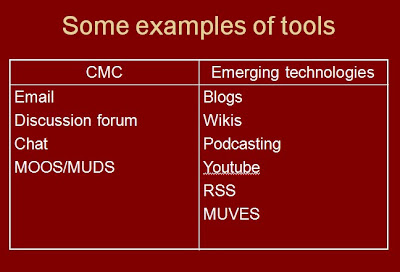
*Post the course materials in instructor’s blog
*Have students work in groups of 4 or 5 and connect to instructor’s blog by wap
*Group members work together to figure out the concepts of these terms.
*Use google in Wap.google.com if needed
*Then have students discuss the question “Are any of these forms of communication more important than the others?”Each group should choose one as the most important.
*Encourage different groups to share their views and evaluate others' views by using qq.

*Each group picks one to generalize group views in class
Home work: students reflect on the CMC and Emerging technologies they learnt by posting on their own blog.

*Post the course materials in instructor’s blog
*Have students work in groups of 4 or 5 and connect to instructor’s blog by wap
*Group members work together to figure out the concepts of these terms.
*Use google in Wap.google.com if needed
*Then have students discuss the question “Are any of these forms of communication more important than the others?”Each group should choose one as the most important.
*Encourage different groups to share their views and evaluate others' views by using qq.

*Each group picks one to generalize group views in class
Home work: students reflect on the CMC and Emerging technologies they learnt by posting on their own blog.
Reflections and Implications of Hi-Tech in a Zero-Computer Class
Today, as the development of mobile communication technology and people's demands for education are increasing constantly, mobile learning on the basis of mobile communication technology and mobile Internet technology emerges, as the times require. Mobile learning is the combination of E-learning and wireless technological, which brings brand-new experience of study whenever and wherever possible to learners. Mobile learning gradually comes true with the progress of mobile communication technology and other wireless access technologies and with the popularization of wireless and mobile devices progressively, which is becoming a kind of study way of people's. Mobile learning’s ambulant, efficiency, extensive, interaction, sharing of study, individualized etc, these study characteristic make the learners not confine to the computer again, they can study "at any time, everywhere, with anyone". Lesley also in her blog http://lovelovelesley.blogspot.com/ discussed the possibility of using “Mobile Assisted Language Learning” in China which I think feasible and practical.
In practice, college students in my working context are more interested in the WAP mobile learning, especially the QQ blogging mode. Students are strongly motivated when instructor comments their QQ blogs. Some students even commented my QQ blog when attending class. It’s quite inspiring for teachers to do something.
My approach regards WAP technology as supported, and English study as the research object, have developed the English study platform under the environment on the basis of WAP mobile learning.
Let’s see whether it works to construct a WAP mobile learning environment.
Take Nokia E-71 as example

Chose connectivity to connect the Mobile Internet (WAP)


Task 1
Adding friends
*Click on Friend’s list
*Type in her/his ID
* Search
*Add your friend student B in search result

New post
*Click on New post on Dashboard
*Write the title and the content
*Add picture if needed
*Add QQ Emoticon if needed(quite popular)
*Submit


Commenting
*Click on Updates of friends in Dashboard
*Click on the second post of student B
*Type in “I can’t agree with you” as comment,
*Submit
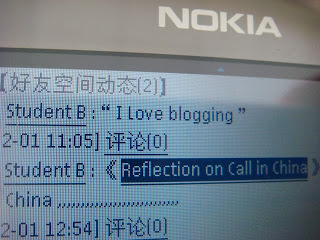

Task 4
Viewing updates of own blog
*Click on Blog archive in dashboard
*View the visit times and comment times
*Click on the post “Reflection on the reading”
*View the comment by student B
*Reply to the comment



Task 5
Locating the visitor
*Click on friends’ list in dashboard
*Locating

QQ blog Vs Blogger (tested)
Time to log in
QQ blog : 38 seconds
Blogger: 35 seconds
Time to a add a friend:
QQ blog: 28 seoncds
Blogger: 30 seconds
The disadvantages of QQ blog lie in its language option, video and audio functions, and the recognition of using cell phone in class. But I’m personally optimistic toward the rapid development of 3G and Andriod platform. That’s why Tencent (0070 HK) is worthy of 148.70 HK dollar and China Mobile (0941 HK) 75.70 HK dollar in HK stock market.
Teaching implications
Post the course materials in instructor’s blog

*Have students work in groups of 4 or 5 and connect to instructor’s blog by Wap
*Group members work together to figure out the concepts of these terms.
*Use Google in Wap.google.com if needed
*Then have students discuss the question “Are any of these forms of communication more important than the others?” Each group should choose one as the most important.
*Encourage different groups to share their views and evaluate others' views by using qq.
*Each group picks one to generalize group views in class
Home work: students reflect on the CMC and Emerging technologies they learnt by posting on their own blog.
In practice, college students in my working context are more interested in the WAP mobile learning, especially the QQ blogging mode. Students are strongly motivated when instructor comments their QQ blogs. Some students even commented my QQ blog when attending class. It’s quite inspiring for teachers to do something.
My approach regards WAP technology as supported, and English study as the research object, have developed the English study platform under the environment on the basis of WAP mobile learning.
Let’s see whether it works to construct a WAP mobile learning environment.
Take Nokia E-71 as example

Chose connectivity to connect the Mobile Internet (WAP)

Log in QQ blog (the most common and popular blog among students) powered by TENCENT (0700.HK)

The Dashboard of QQ blog (Assuming you are Student A)

Ok, let’s try the functions of QQ blog.
Task 1
Adding friends
*Click on Friend’s list
*Type in her/his ID
* Search
*Add your friend student B in search result

Task 2
New post
*Click on New post on Dashboard
*Write the title and the content
*Add picture if needed
*Add QQ Emoticon if needed(quite popular)
*Submit


Task 3
Commenting
*Click on Updates of friends in Dashboard
*Click on the second post of student B
*Type in “I can’t agree with you” as comment,
*Submit


Viewing updates of own blog
*Click on Blog archive in dashboard
*View the visit times and comment times
*Click on the post “Reflection on the reading”
*View the comment by student B
*Reply to the comment


Task 5
Locating the visitor
*Click on friends’ list in dashboard
*Locating

QQ blog Vs Blogger (tested)
Time to log in
QQ blog : 38 seconds
Blogger: 35 seconds
Time to a add a friend:
QQ blog: 28 seoncds
Blogger: 30 seconds
The disadvantages of QQ blog lie in its language option, video and audio functions, and the recognition of using cell phone in class. But I’m personally optimistic toward the rapid development of 3G and Andriod platform. That’s why Tencent (0070 HK) is worthy of 148.70 HK dollar and China Mobile (0941 HK) 75.70 HK dollar in HK stock market.
Teaching implications
Post the course materials in instructor’s blog

*Have students work in groups of 4 or 5 and connect to instructor’s blog by Wap
*Group members work together to figure out the concepts of these terms.
*Use Google in Wap.google.com if needed
*Then have students discuss the question “Are any of these forms of communication more important than the others?” Each group should choose one as the most important.
*Encourage different groups to share their views and evaluate others' views by using qq.
*Each group picks one to generalize group views in class
Home work: students reflect on the CMC and Emerging technologies they learnt by posting on their own blog.
Subscribe to:
Posts (Atom)